Overview
ShAU-PZ Fire Valve Control Cabinets: Description and Functionality
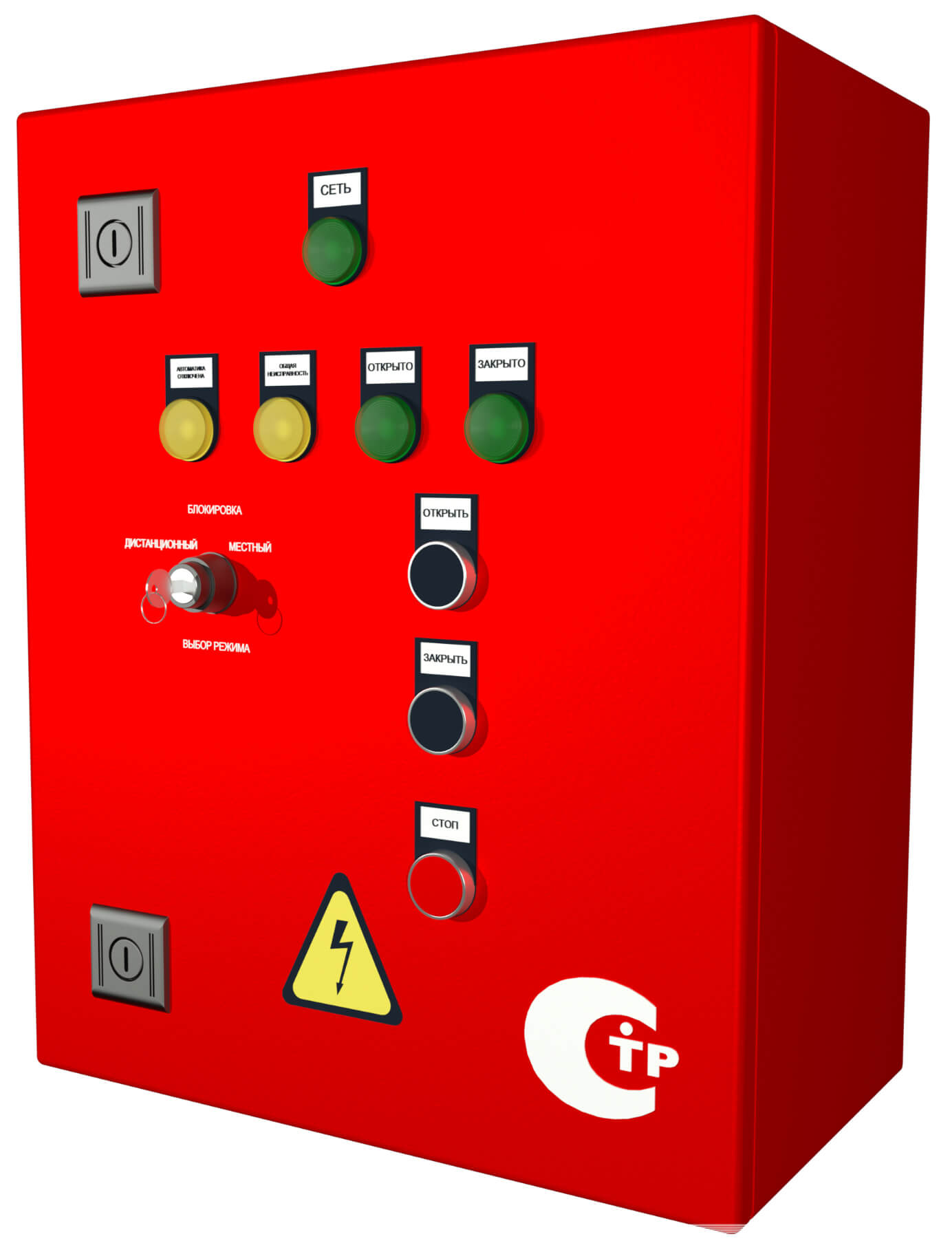
ShAU-PZ series cabinets are designed to control shut-off valves in fire protection systems. The equipment provides valve positioning in two extreme states: "Open" and "Closed."
Main Features
The device supports two control modes:
- "Local" Manual control from the cabinet panel;
- "Remote"—control via external signals.
The cabinet is compatible with asynchronous electric motors:
- Single-phase (1 x 220V);
- Three-phase (3 x 380V).
Operating Algorithm
1. Switching Modes
The front panel has a three-position switch:
- "Remote";
- "Lock" (blocks the electric motor from starting);
- "Local".
2. Local Mode
Control is carried out using the buttons on the panel:
3. Remote Mode
Commands come from:
- Fire control panel (FCP);
- Fire alarm control panel (FACP);
- Remote start devices (RSD).
Variations for activating the valve opening:
- Supplying 24V DC from an external source (via the FACP/FACP voltage output);
- Using the cabinet`s built-in power supply when an external dry contact is closed (via the potential-free output of the control panel/fire alarm control unit or the contacts of the control panel).
The valve closes when the control voltage is removed from the terminal block.
4. Position Monitoring and Emergency Situations
- Opening/closing occurs until the limit switches are triggered. In this case:
- the corresponding indicator on the panel lights up;
- the control contacts close.
- If the valve jams, an emergency stop is triggered by a signal from the torque switches.
- In cases of a line break, short circuit, overcurrent, or overheating (when a thermal contact is connected):
- the "General Fault" contact closes;
- the alarm indicator on the panel is activated.
Compliance with fire safety requirements Safety
ShAU-PZ cabinets comply with technical regulations (Federal Law No. 123 of July 22, 2008, GOST R 53325-2012):
- Power line integrity monitoring—if a line is broken, a "General fault" signal and corresponding indicator are activated.
- Protection against unauthorized access—controls are locked to prevent accidental or unauthorized tampering.
Those. information
Control Cabinet Upgrade Options
The standard cabinet configuration allows for flexible configuration by installing additional functional units. This approach allows for optimal adaptation of the equipment to the specifics of the facility and its operating conditions.
Available Expansion Modules
1. Communication Tools for Data Exchange
- Modbus RTU
- Enables bidirectional data exchange via the industrial RS-485 interface. Suitable for building distributed systems with a serial connection topology.
- Modbus TCP/IP
- Allows the cabinet to be integrated into a local area network or corporate IT infrastructure via a standard Ethernet port. Implements remote management and monitoring via IP protocol.
2. Climate rating options
-
UKHL1
- Operating temperature range: -60°C +40°C;
- Placement in open areas without protective structures is permitted.
-
UKHL2
- Operating temperature range: -40°C +40°C;
- Possible placement options:
- Under cover (excluding direct exposure to precipitation and solar radiation);
- In rooms without a heating system.
Important: Both design options fully comply with current GOST requirements for equipment climatic resistance.
Advantages of a modular configuration
The introduction of additional modules provides a number of significant operational benefits:
- Expanded monitoring functionality—the ability to remotely monitor parameters and control them in real time;
- Increased climatic resistance— Adaptation to harsh weather conditions, including extreme temperatures;
- Improved integration—easy integration into existing utility systems and facility networks.
Recommendations for ordering modified equipment
When selecting additional options, it is advisable to clarify the following points:
- Compatibility—checking the correct interaction of new modules with the basic cabinet configuration;
- Dimensions—accounting for possible changes in cabinet dimensions after installing additional equipment;
- Installation and configuration— The physical placement of modules and their configuration procedures are specific.
This approach ensures optimal operation of the upgraded control cabinet under specified operating conditions.