




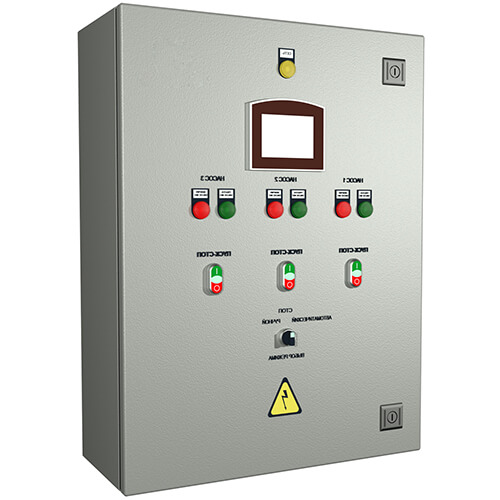
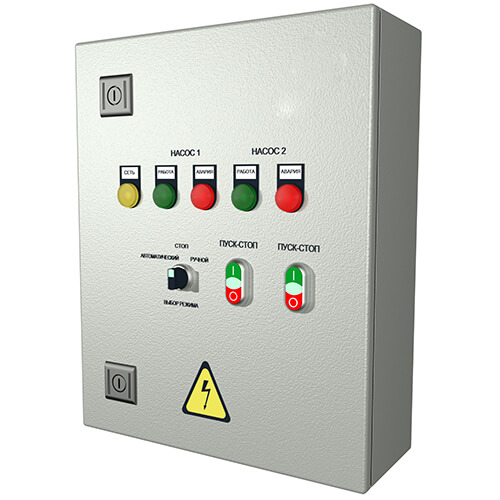
How are control cabinets classified?
There are several main approaches to categorizing control cabinets.
1. Depending on the type of pumps being serviced:
- For drainage and sewage pumps.They ensure optimal operation, eliminate the risk of overheating and idle running.
- For borehole pumps.They control the transportation of water (including drinking water), and are used in agricultural enterprises and food production.
- For submersible pumps.They are designed for fire and irrigation systems, resistant to high humidity and high temperatures.
- For deep-well pumps.They guarantee a soft start, regulate the motor speed, and maintain the set pressure in the pipeline.
2. By control principle:
- Relay-based. They are characterized by simple design and operation, providing direct start-up of equipment.
- With a frequency converter. They allow smooth adjustment of engine speed, leading to reduced energy costs.
- With a soft starter (SSD). They minimize mechanical loads and prevent water hammer.
3. By the number of controlled pumps. Options range from single control to cascade control of multiple units.
Functional Capabilities
The range of SHUN features varies depending on the model, but most often includes:
- automated pump on/off switching based on sensor data (float, pressure, level, etc.);
- soft start and stop of units to prevent hydraulic shock;
- protection against overloads, short circuits, dry running, overheating, and other abnormal conditions;
- monitoring of key system parameters (pressure, level, temperature);
- ability to switch between manual, automatic, and remote control modes;
- metering of the volume of pumped liquid;
- connection to control systems via network modules.
Control cabinet composition
A typical control cabinet configuration includes the following elements:
- metal housing (stainless steel or plastic in aggressive environments);
- front panel with controls and operating mode indicators;
- protective devices (fuses, contactors, phase control relays);
- frequency converters or soft starters (depending on the model);
- measuring sensors (level, pressure, temperature);
- terminal blocks for connecting equipment.
Where pump control cabinets are used
The scope of use of the control cabinet covers:
- housing and communal services (systems) water supply, sewerage, heating);
- autonomous utility networks of residential and commercial properties;
- fire protection systems;
- industrial enterprises (liquid pumping, hydraulics);
- wastewater treatment plants and agricultural facilities (irrigation, farm water supply).
What to look for when choosing
When selecting a control cabinet, it is important to consider the following parameters:
- number of pumps to be controlled;
- preferred control method (direct start, frequency regulation, soft start);
- electrical network characteristics (voltage, frequency);
- required enclosure protection class (IP) taking into account operating conditions;
- availability of additional options (remote monitoring, integration with systems) (dispatch).
To select the right model, it`s advisable to consult with the manufacturer or supplier, who will analyze the technical requirements and features of the facility.
If you need help choosing a control cabinet based on your specific needs, please describe them, and I`ll help you find the optimal solution.